


Call us and get your quote!
10% Off Your First Custom Part
-Start Today!
Send your drawings for a free review and quick quote. Our engineers are here to help.
ISO certified | Fast delivery | Factory Direct

Kintec Machining provides custom copper CNC machining services for prototypes, low-volume production, and precision copper components with consistent quality and fast lead times.

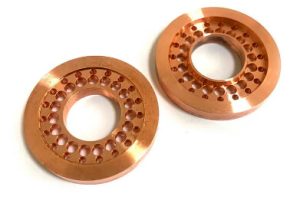
Copper is a highly versatile metal widely used in CNC machining due to its outstanding electrical conductivity, thermal conductivity, corrosion resistance, and dimensional stability. Its unique combination of physical properties makes copper an ideal material for manufacturing precision components used in electrical, electronics, aerospace, automotive, and industrial applications.
01
Copper has one of the highest electrical conductivity levels among engineering metals, making it the preferred choice for electrical and electronic components.
02
Copper provides excellent heat transfer capability, allowing components to efficiently dissipate heat during operation.
03
Copper naturally forms a protective oxide layer that improves resistance to corrosion and environmental exposure.
04
Copper can be accurately machined with CNC milling and CNC turning processes when proper tooling and cutting parameters are applied.
05
Copper has a naturally attractive metallic appearance and can achieve premium finishes through polishing, plating, and coating processes.
06
Different copper grades provide different combinations of conductivity, strength, hardness, and machinability.
Selecting the correct copper grade is important for achieving the required electrical performance, mechanical properties, and machining efficiency.
C110 copper, also known as Electrolytic Tough Pitch (ETP) copper, is one of the most commonly used copper grades for CNC machining.It offers excellent electrical conductivity, thermal conductivity, and corrosion resistance, making it suitable for electrical and industrial applications.
| Tensile Strength, Yield (MPa) | Fatigue Strength (MPa) | Elongation at Break (%) | Hardness (Brinell) | Density (g/cm³) |
|---|---|---|---|---|
| 70 | 97 | 55 | 35 | 8.94 |
C101 copper is an oxygen-free copper grade with extremely high purity and excellent electrical conductivity.It is commonly selected for high-performance electrical and electronic applications requiring reliable conductivity.
| Tensile Strength, Yield (MPa) | Fatigue Strength (MPa) | Elongation at Break (%) | Hardness (Brinell) | Density (g/cm³) |
|---|---|---|---|---|
| 69 | 97 | 45 | 40 | 8.94 |
C102 copper is an oxygen-free copper grade known for excellent electrical conductivity, thermal performance, and corrosion resistance.It is suitable for applications requiring high electrical reliability and long service life.
| Tensile Strength, Yield (MPa) | Fatigue Strength (MPa) | Elongation at Break (%) | Hardness (Brinell) | Density (g/cm³) |
|---|---|---|---|---|
| 70 | 95 | 50 | 45 | 8.94 |
C145 tellurium copper is designed to improve machinability while maintaining excellent electrical conductivity.It is commonly used for precision CNC machining applications requiring both conductivity and manufacturing efficiency.
| Tensile Strength, Yield (MPa) | Fatigue Strength (MPa) | Elongation at Break (%) | Hardness (Brinell) | Density (g/cm³) |
|---|---|---|---|---|
| 220 | 100 | 15 | 75 | 8.89 |
C172 beryllium copper provides high strength, excellent wear resistance, and good electrical conductivity.It is suitable for demanding applications requiring superior mechanical performance.
| Tensile Strength, Yield (MPa) | Fatigue Strength (MPa) | Elongation at Break (%) | Hardness (Brinell) | Density (g/cm³) |
|---|---|---|---|---|
| 965 | 275 | 5 | 350 | 8.25 |
Copper CNC machined parts can be finished with various surface treatments to improve appearance, corrosion resistance, durability, and functional performance.Because copper has excellent conductivity and a naturally attractive metallic appearance, surface finishing is often used to enhance both aesthetic value and long-term performance.
Common surface finishes for CNC copper parts include:
Copper provides superior electrical performance, making it ideal for power transmission and electronic components.
Copper efficiently transfers heat, making it suitable for cooling and thermal management applications.
Copper provides reliable performance in moisture and many industrial environments.
CNC machining allows copper parts to achieve tight tolerances and complex designs.
Copper offers an attractive metallic finish suitable for functional and decorative components.
Copper is generally more expensive than aluminum and steel because of its higher material value.
Pure copper is softer and more ductile, making it more challenging to machine compared with brass alloys.
Copper transfers heat quickly, requiring optimized cutting parameters and suitable tooling.
Copper CNC parts are commonly used in aerospace, automotive, electronics, and industrial equipment because of their lightweight design, durability, and excellent machinability..
Copper components are used for thermal and electrical systems requiring high reliability.
Applications:
Copper parts provide reliable performance in industrial systems.
Applications:
Copper components are used in precision electronic and specialized equipment.
Applications:
Copper CNC machining supports power generation and energy equipment.
Applications:Transformer components,Power connectors,Electrical distribution parts.
Copper CNC parts support modern vehicle electrical and thermal systems.
Applications:Battery connectors,Charging components,Electrical terminals.
Copper CNC parts are widely used due to excellent electrical conductivity.
Applications:
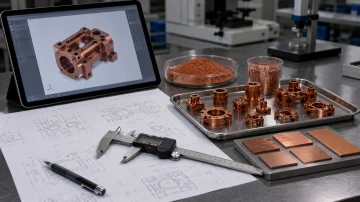
The most common CNC machining copper grades include C110, C101, C102, C145, and C172. Each grade provides different combinations of conductivity, strength, and machinability.
Yes. Copper can be CNC machined into precision components with excellent electrical performance, tight tolerances, and smooth surface finishes.
Copper provides higher electrical and thermal conductivity, while brass generally provides better machinability and lower machining costs.
Common copper surface finishes include:Polishing,Brushing,Nickel plating,Tin plating,Electroless coating.
CNC copper components are widely used in electrical, aerospace, automotive, medical, energy, and industrial applications.
Kintec provides custom Copper CNC machining services for aerospace, automotive, medical, robotics, and industrial applications. Contact us to discuss your requirements and get a fast quotation.
Send your drawings for a free review and quick quote. Our engineers are here to help.
ISO certified | Fast delivery | Factory Direct