



Call us and get your quote!
10% Off Your First Custom Part
-Start Today!
Send your drawings for a free review and quick quote. Our engineers are here to help.
ISO certified | Fast delivery | Factory Direct

Kintec Machining provides precision titanium CNC machining services for prototypes, custom components, and low-volume production with tight tolerances and consistent manufacturing quality.

Titanium is a high-performance metal widely used in CNC machining for applications requiring an excellent combination of strength, low weight, corrosion resistance, and high-temperature performance. With a high strength-to-weight ratio and outstanding resistance to harsh environments, titanium CNC machining is commonly used for aerospace, medical, automotive, chemical processing, and high-performance industrial components.
01
Titanium provides an excellent balance of strength and low density, allowing engineers to manufacture strong components without adding unnecessary weight.
02
Titanium naturally forms a stable oxide layer that provides excellent resistance to corrosion in moisture, seawater, and many chemical environments.
03
Many titanium alloys maintain their mechanical performance under elevated-temperature conditions.This makes titanium suitable for demanding applications where components must withstand heat, mechanical stress, and harsh operating environments.
04
Titanium is highly biocompatible and is widely used in medical and dental applications.
05
Different titanium grades are designed for different engineering requirements.
06
Scrap and swarf are recycled at high value, keeping material cost predictable.
Choosing the right titanium grade is important because different grades provide different combinations of strength, corrosion resistance, ductility, machinability, and application performance.
Grade 2 commercially pure titanium provides an excellent balance of corrosion resistance, ductility, and moderate strength.It is one of the most commonly used commercially pure titanium grades for CNC machining and is suitable for applications requiring excellent resistance to corrosive environments.
| Tensile Strength, Yield (MPa) | Fatigue Strength (MPa) | Elongation at Break (%) | Hardness (Brinell) | Density (g/cm³) |
|---|---|---|---|---|
| 275 | 240 | 20 | 160 | 4.51 |
Grade 5 titanium, also known as Ti-6Al-4V, is the most widely used titanium alloy. It provides an excellent combination of high strength, low weight, corrosion resistance, and fatigue performance.This grade is widely selected for high-performance titanium CNC machining applications.
| Tensile Strength, Yield (MPa) | Fatigue Strength (MPa) | Elongation at Break (%) | Hardness (Brinell) | Density (g/cm³) |
|---|---|---|---|---|
| 880 | 510 | 14 | 334 | 4.43 |
Grade 23 titanium, also known as Ti-6Al-4V ELI, is an extra-low interstitial version of Grade 5 titanium.It provides improved ductility, fracture toughness, and biocompatibility, making it particularly suitable for medical and demanding aerospace applications.
| Tensile Strength, Yield (MPa) | Fatigue Strength (MPa) | Elongation at Break (%) | Hardness (Brinell) | Density (g/cm³) |
|---|---|---|---|---|
| 795 | 510 | 15 | 334 | 4.43 |
Grade 7 titanium is a commercially pure titanium alloy with a small addition of palladium to improve corrosion resistance.It is particularly suitable for chemical processing environments where resistance to reducing acids and aggressive chemicals is required.
| Tensile Strength, Yield (MPa) | Fatigue Strength (MPa) | Elongation at Break (%) | Hardness (Brinell) | Density (g/cm³) |
|---|---|---|---|---|
| 275 | 240 | 20 | 160 | 4.51 |
Grade 9 titanium, also known as Ti-3Al-2.5V, provides a good balance of strength, ductility, corrosion resistance, and relatively improved formability.It is suitable for lightweight components requiring reliable mechanical performance and corrosion resistance.
| Tensile Strength, Yield (MPa) | Fatigue Strength (MPa) | Elongation at Break (%) | Hardness (Brinell) | Density (g/cm³) |
|---|---|---|---|---|
| 620 | 380 | 15 | 260 | 4.48 |
Titanium CNC machined parts can be processed with different surface finishing methods to improve appearance, corrosion resistance, wear resistance, and functional performance.
Titanium provides high mechanical strength while remaining significantly lighter than many steel alloys.
Titanium provides reliable long-term performance in marine, chemical, and other corrosive environments.
Titanium alloys can withstand repeated mechanical loading, making them suitable for demanding structural applications.
Certain titanium grades are suitable for medical and dental components due to their excellent compatibility with the human body.
Titanium alloys can maintain reliable mechanical performance in demanding temperature environments.
Titanium CNC machining provides outstanding strength-to-weight performance and corrosion resistance, but its low thermal conductivity and tendency to generate heat during machining require carefully optimized manufacturing processes.
Titanium is generally more expensive than aluminum and many steel alloys.
Titanium has low thermal conductivity, which can concentrate heat at the cutting zone and increase tool wear.
Titanium often requires carefully controlled cutting speeds, feeds, and depths of cut, which may increase machining time.
Proper tooling, workholding, coolant strategies, and machining parameters are important for achieving consistent titanium CNC machining results.
Titanium provides excellent corrosion resistance in demanding chemical environments.
Applications include:
Titanium CNC machined components provide excellent resistance to seawater and harsh marine environments.
Applications include:
Titanium CNC parts are used in high-performance automotive applications where weight reduction and strength are important.
Applications include:Engine components,Exhaust components,Suspension components,Racing components
Titanium is used in specialized industrial and energy applications requiring high strength, corrosion resistance, and long-term durability.
Applications include:Power equipment,Industrial machinery,Heat transfer systems,High-performance mechanical components
Titanium is widely used for medical components because of its biocompatibility and corrosion resistance.
Applications include:Medical implants,Orthopedic components,Surgical instruments,Dental components
Titanium CNC machined parts are widely used in aerospace because of their high strength-to-weight ratio, fatigue resistance, and corrosion resistance.
Applications include:Aircraft components,Structural parts,Engine components,Aerospace brackets
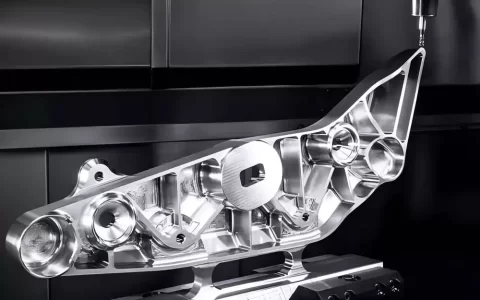
The most common titanium grades include Grade 2, Grade 5 Ti-6Al-4V, Grade 23 Ti-6Al-4V ELI, Grade 7 Ti-Pd, and Grade 9 Ti-3Al-2.5V.
Titanium is more difficult to machine than aluminum because it has low thermal conductivity and can generate significant heat during machining. Professional CNC machining requires optimized tooling, cutting parameters, and coolant strategies.
Grade 5 Ti-6Al-4V is one of the most widely used titanium grades for CNC machining because it provides an excellent combination of strength, low weight, corrosion resistance, and mechanical performance.
Grade 23 Ti-6Al-4V ELI has lower interstitial element content than Grade 5 and provides improved ductility, fracture toughness, and biocompatibility. It is commonly used for medical and demanding aerospace applications.
Common finishes include polishing, brushing, bead blasting, anodizing, passivation, and PVD coating.
Kintec Machining provides precision titanium CNC machining services for prototypes, custom components, and low-volume production.
From Grade 2 commercially pure titanium to high-strength Grade 5 Ti-6Al-4V and medical-grade Grade 23 titanium, our CNC machining capabilities support complex geometries, tight tolerances, and demanding application requirements.
Send your drawings for a free review and quick quote. Our engineers are here to help.
ISO certified | Fast delivery | Factory Direct