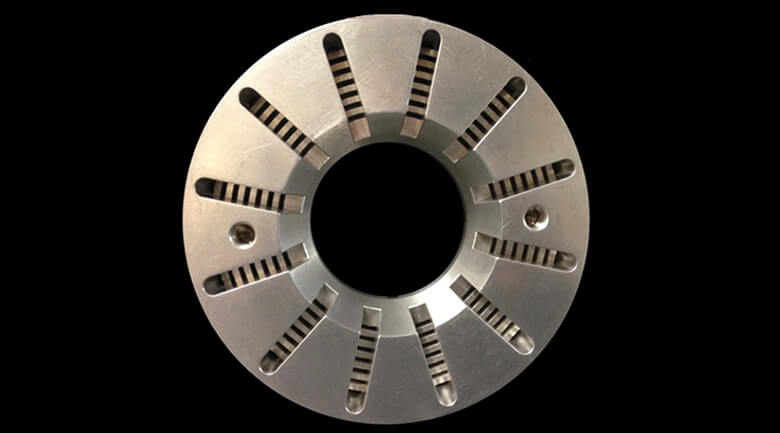
The 14 Parts That Didn’t Exist Anywhere
Aisha is a mechanical engineer at a robotics startup. Last spring she opened a folder and counted fourteen parts she needed for a prototype: a motor mount, sensor housings, harmonic-drive plates, brackets, a base flange, and custom shafts. None existed off-the-shelf. Every catalog supplier either refused the mixed order or quoted absurd minimums. She sent the folder to a real CNC shop. They machined all fourteen as a single mixed batch in just over a week. Her robot ran on the test rig the following Monday.
That’s what CNC machining parts really are: everything that doesn’t fit the catalog.
What Are CNC Machining Parts?
CNC machining parts are custom components cut from solid stock by computer-controlled machines following your CAD file. Because there’s no mold or die, every part is made to order — from a single prototype to thousands per run. They show up across aerospace (brackets, impellers), medical (implants, instruments), automotive and EV (shafts, housings), robotics (joint mounts, custom shafts), and electronics (heat sinks, connector pins).
Materials and Tolerances for CNC Machining Parts
| Material | Typical Use | Tolerance Reach |
|---|---|---|
| Aluminum 6061 / 7075 | Housings, brackets, robotics | ±0.013 mm |
| Stainless 303 / 316 / 17-4PH | Medical, marine, instruments | ±0.013 mm |
| Titanium Ti-6Al-4V | Aerospace, implants | ±0.005 mm |
| Brass / copper | Electrical contacts, RF, fittings | ±0.013 mm |
| PEEK / PTFE / POM | Seals, insulators, medical | ±0.025 mm |
Apply tight tolerances only where the feature mates, seals, or locates. Everything else stays general (±0.13 mm) — and you stay on budget. One example: an engineer once spec’d 304 stainless on a connector housing for corrosion resistance. The part also needed to machine fast. Switching to 303 — a free-machining variant with the same corrosion performance — cut his cycle time nearly in half. Right material, right reason.
Lead times track complexity, not just cutting time. Simple prototypes ship in 3–7 days, complex 5-axis parts in 1–2 weeks, low-volume runs in 2–4 weeks, and orders with anodizing or full documentation add another week or two on top.
How to Source High-Quality CNC Machining Parts
The hardest part of buying custom machined parts isn’t the design — it’s avoiding the supplier who doesn’t actually make them. A real shop owns the machines, names the operator, and shows you the floor on a video call. A broker routes your file to a subcontractor and brands the result as theirs. Before you place an order, verify equipment ownership, ISO 9001:2015 certification, CMM inspection, and material certs traceable to the mill heat number.
FAQ: CNC Machining Parts
What materials are used for CNC machined parts?
Aluminum, stainless and alloy steels, titanium, brass, copper, and engineering plastics like PEEK, PTFE, and POM.
What tolerances can CNC machining parts hold?
General around ±0.005″, precision to ±0.0005″, and high-precision aerospace or medical features to ±0.0002″ with the right equipment.
What’s the minimum order?
A capable shop will run a single piece. The economics improve as quantity rises, but there is no technical minimum.
Tired of Receiving CNC Parts That Aren't What You Paid For?
the CMM report you asked for doesn’t exist. Kintec Machining is built so that conversation never happens.
- Free DFM review on every drawing
- CMM reports and traceable material certs with every order
- Milling, turning, 5-axis & Swiss in one shop
- Honest 24-hour quotes