5 axis technology gets talked about as a capability checkbox on a supplier’s website, but what it actually changes is how many times a part has to be unclamped and repositioned before it’s finished — and every one of those repositions is a chance for error to creep in. For engineers designing parts with curved surfaces, angled bosses, or features that don’t sit neatly on one face, understanding what 5-axis machining actually does differently from standard 3-axis equipment is the difference between specifying a part that’s straightforward to quote and one that gets bounced back for redesign. This guide covers how the technology works, where it earns its cost, and how to tell if your part actually needs it.
What 5 Axis Technology Actually Means
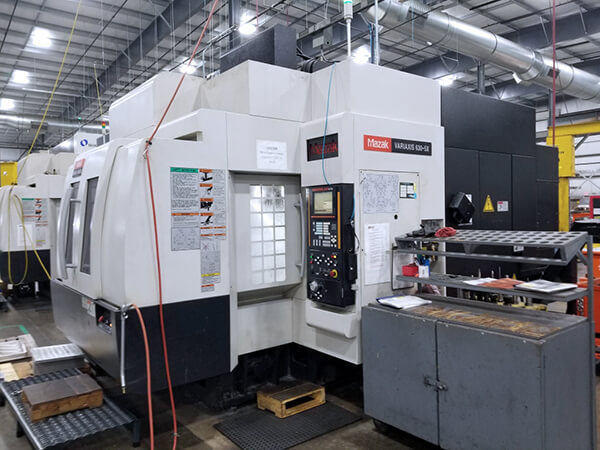
A standard CNC milling machine moves a cutting tool along three linear axes — X, Y, and Z. 5-axis machines add two rotational axes, letting the tool or the workpiece tilt and rotate so the cutting tool can approach a part from nearly any angle. That extra freedom is what lets a single setup reach surfaces, undercuts, and angled features that would otherwise require multiple manual repositions on a 3-axis machine.
3-Axis vs 5-Axis CNC Machining: What Actually Changes
| Factor | 3-Axis Machining | 5-Axis Machining |
|---|---|---|
| Tool movement | Linear along X, Y, Z only | Linear plus rotation on two additional axes |
| Tool access | Top-down, single approach angle | Multi-directional, nearly any angle |
| Setups for complex parts | Multiple manual re-fixtures | Single or few setups |
| Positional accuracy on complex geometry | Lower — error compounds per setup | Higher — fewer repositioning steps |
| Surface finish on curved features | Stepped, often needs secondary polishing | Continuous, smoother as-machined |
| Best fit | Flat, simple pocketed parts | Impellers, gimbals, aerospace contours |
Simultaneous vs Indexed 5-Axis Machining
Not all 5-axis equipment operates the same way, and the distinction matters for both cost and capability. Indexed (3+2) machining rotates the part to a fixed angle, locks it in place, then cuts using standard 3-axis movement — effective for parts with several angled faces that don’t need continuous curved tool paths. Simultaneous 5-axis machining moves all five axes at once during the cut, producing continuous curved surfaces that indexed machining can’t replicate, at a higher programming and machine-time cost.
| Factor | Indexed (3+2) Machining | Simultaneous 5-Axis Machining |
|---|---|---|
| Tool movement during cut | 3-axis only, part locked at an angle | All 5 axes move together continuously |
| Best for | Multiple flat or angled faces | Continuous curved surfaces, blades, impellers |
| Programming complexity | Lower | Higher |
| Relative cost | Lower | Higher, justified by geometry that needs it |
Practical Examples of 5 Axis Technology in Use
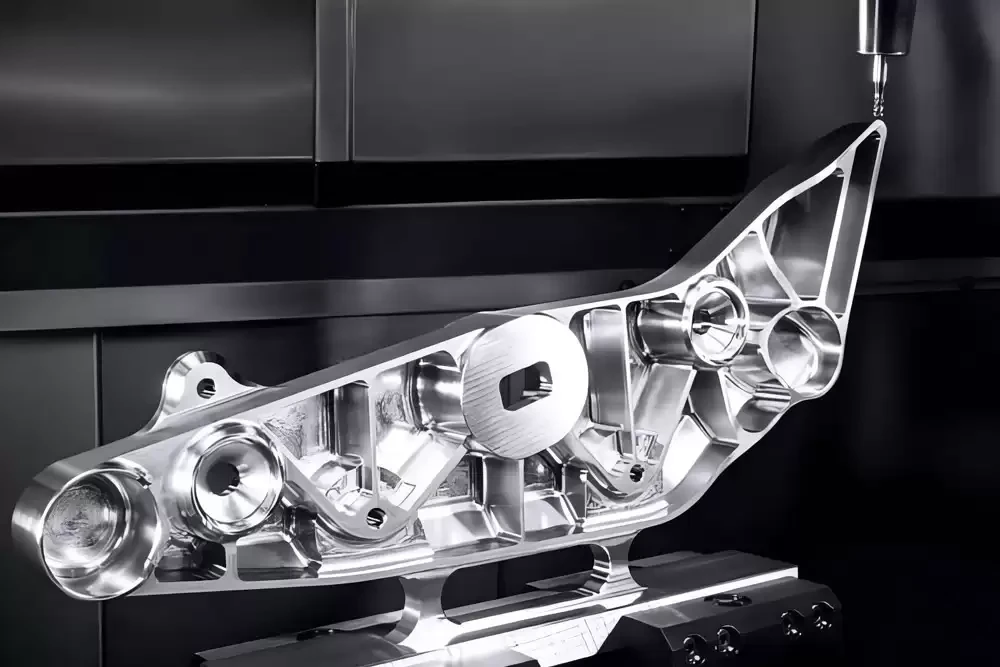
- Aerospace turbine impellers: curved blade geometry cut from solid aluminum or titanium billet using simultaneous 5-axis tool paths.
- UAV gimbal housings: angled bearing bores and mounting faces machined in one setup instead of four separate repositions.
- Robotics joint housings: compound-angle features completed without the stack-up error that comes from manual re-fixturing.
- Medical instrument components: anatomically curved surfaces machined to a continuous, polish-free finish.
- Automotive sensor mounts: angled mounting faces cut alongside the main body in a single operation.
Why Setup Count Matters More Than the Tolerance Number Alone
Every time a part is unclamped and repositioned on a 3-axis mill, a small amount of positional error gets introduced — often invisible on a single-dimension check, but easy to notice once several interrelated features stop lining up. A part machined in one or two setups on 5-axis equipment avoids that compounding error almost entirely, which is why two quotes with the same tolerance printed on the drawing can produce very different real-world consistency once the part is actually assembled.
Materials, Tolerances & Lead Times for 5-Axis Parts
Material rigidity affects how well a part holds up during multi-axis cutting, particularly on thin or overhanging features where vibration risk is higher than on a simple block part.
| Material | Common 5-Axis Application | Typical Tolerance | Standard Lead Time |
|---|---|---|---|
| Aluminum 6061 / 7075 | Impellers, drone frames, robotics housings | ±0.013 mm | 5–8 days |
| Titanium Ti-6Al-4V | Aerospace structural contours | ±0.005 mm | 7–10 days |
| Stainless 17-4PH | Medical instrument curved components | ±0.005 mm | 6–9 days |
| PEEK | Lightweight curved medical/aerospace parts | ±0.025 mm | 6–8 days |
When 5 Axis Technology Is Worth the Added Cost
5-axis machining earns its premium on parts with genuinely complex geometry — curved blades, compound-angle mounting faces, undercuts inaccessible from a single direction. For a part that’s fundamentally flat with a few pocketed features, standard 3-axis or indexed machining is usually the more cost-effective choice; the value of 5-axis shows up specifically where repeated 3-axis setups would either be impossible or would introduce unacceptable positional error.
How to Specify a 5-Axis Machined Part Correctly
Flag which surfaces genuinely require continuous curved tool paths versus which could be produced with simpler indexed setups, since that distinction changes both cost and lead time significantly. Confirm the shop runs 5-axis equipment in-house rather than subcontracting complex features, and check quality certifications and case studies for real examples of comparable geometry produced, not just a capability list on a website.
FAQ: 5 Axis Technology
What’s the difference between 3-axis and 5-axis CNC machining?
3-axis machines move a tool along X, Y, and Z only; 5-axis machines add two rotational axes, letting the tool approach a part from nearly any angle in a single setup.
Is 5-axis machining always more expensive than 3-axis?
Generally yes on a per-hour basis, but it can be more cost-effective overall for complex parts by eliminating the multiple setups and secondary finishing a 3-axis process would require.
What’s the difference between indexed and simultaneous 5-axis machining?
Indexed (3+2) machining locks the part at a fixed angle and cuts with standard 3-axis movement; simultaneous 5-axis machining moves all axes together during the cut, producing continuous curved surfaces.
Does every complex part need simultaneous 5-axis machining?
No — many parts with multiple angled faces are handled efficiently with indexed 3+2 machining, reserving simultaneous 5-axis for genuinely continuous curved geometry.
Get Your 5-Axis Machining Quote
Kintec runs 5-axis machining in-house alongside milling, turning, and Swiss capability, matching indexed or simultaneous processes to your part’s actual geometry.
- ✅ Simultaneous & indexed 5-axis machining in-house
- ✅ Tolerances to ±0.005 mm on critical features
- ✅ No minimum order — prototype from 1 piece
- ✅ ISO 9001:2015 certified facility
- ✅ 24-hour quote turnaround
👉 Send your drawing now and get a free 5-axis machining quote in 24 hours.