


Call us and get your quote!
10% Off Your First Custom Part
-Start Today!
Send your drawings for a free review and quick quote. Our engineers are here to help.
ISO certified | Fast delivery | Factory Direct

Market reports tend to be written for machine builders, not for the engineers and buyers who order machined parts. But the same forces that move machine sales also shape who has 5-axis capacity, how quickly a shop can quote, and which industries are competing with you for machining hours. These CNC industry insights pull the useful signals out of two recent market reports and translate them into what matters when you source precision components.
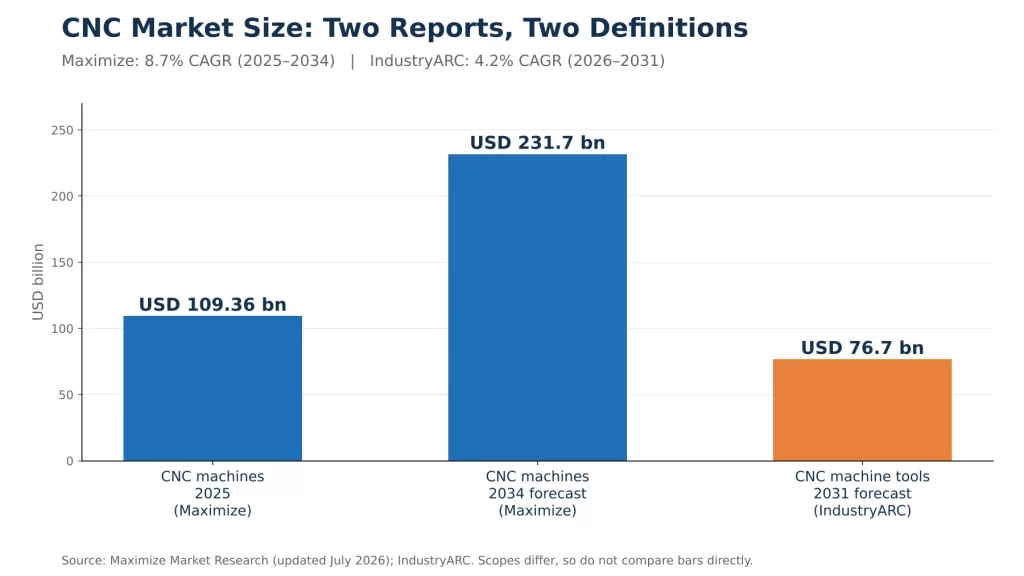
Two syndicated reports give noticeably different numbers, mostly because they measure different things. Maximize Market Research sizes the broader CNC machine market, including hardware, software, and services. IndustryARC covers the narrower CNC machine tool category. Read them as a range, not a single answer.
| Report | Scope | Reported Size | Growth Forecast |
|---|---|---|---|
| Maximize Market Research | CNC machines (hardware, software, services) | USD 109.36 billion in 2025 | 8.7% CAGR to about USD 231.7 billion by 2034 |
| IndustryARC | CNC machine tools | Base year 2025 | 4.2% CAGR to USD 76.7 billion by 2031 |
Both point the same direction: sustained growth, with the pace depending on how the market is defined. Treat the exact figures as estimates from paid research, not audited data.
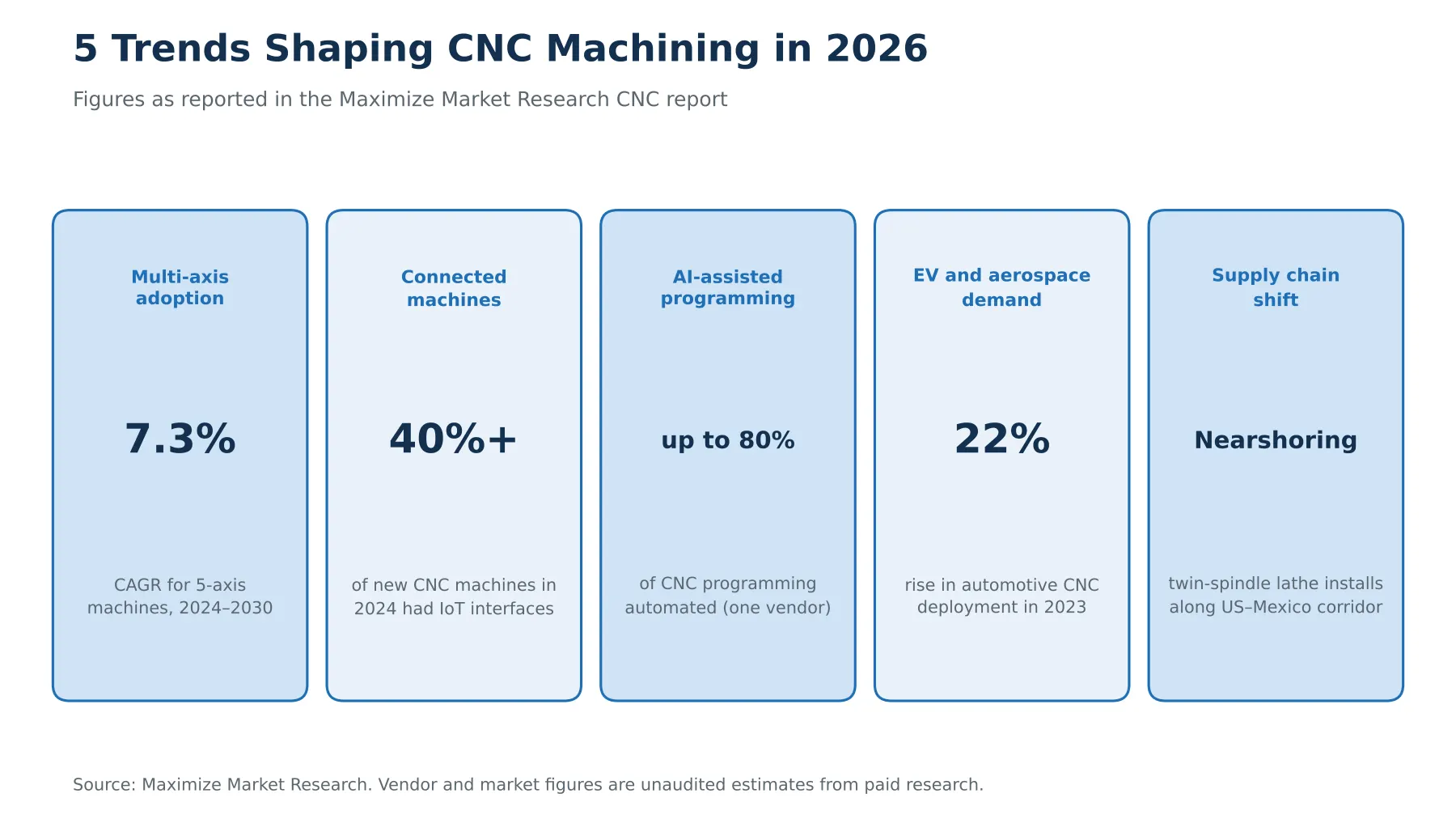
The reports agree on a short list of shifts. Here is what each one means from a buyer’s seat.
| Trend | What the Report Data Says | What It Means When Sourcing Parts |
|---|---|---|
| Multi-axis adoption | 5-axis machines forecast to grow at a 7.3% CAGR from 2024 to 2030 | More shops can quote complex geometry, so ask which ones own the equipment |
| Connected machines | Over 40% of new CNC machines sold in 2024 had IoT-enabled interfaces | Tool wear and utilization data supports more consistent batches |
| AI-assisted programming | One vendor reports automating up to 80% of CNC programming tasks | Faster setup on prototypes, where programming time dominates cost |
| EV and aerospace demand | Automotive CNC deployment reportedly rose 22% in 2023 on battery and motor housing output | Competition for aluminum and titanium machining capacity |
| Nearshoring | Reported surge in twin-spindle lathe installs along the US–Mexico corridor | Supply chains are being re-mapped, so dual-sourcing is worth planning |
Automotive is the largest end-user segment in the Maximize Market Research data, with aerospace and defense, electronics and semiconductor, and medical devices growing behind it. Each pulls on a different part of the machining market.
| Industry | Typical Materials | Typical Tolerance | Typical Lead Time |
|---|---|---|---|
| Automotive and EV | Aluminum, steel | ±0.013 mm | 3–5 days |
| Aerospace and defense | Titanium, aluminum 7075 | ±0.005–0.013 mm | 6–10 days |
| Medical devices | Stainless steel, PEEK | ±0.005–0.025 mm | 5–8 days |
| Electronics and semiconductor | Brass, copper, plastics | ±0.008–0.025 mm | 3–6 days |
| Robotics and automation | Aluminum, stainless | ±0.013 mm | 4–7 days |
Tolerances and lead times above are typical ranges for prototype and low-volume work. Complex geometry or tighter features add time.
According to Maximize Market Research, Asia-Pacific led the market in 2025, driven by manufacturing investment in China, Japan, India, and South Korea. North America ranked second on aerospace, defense, and medical demand, and Europe remains strong in precision engineering. For buyers, this concentration is why many machined-part programs source from Asia while keeping final assembly closer to the customer.
Market growth does not automatically translate into better supplier quality, so the practical response is to verify capability rather than assume it. Ask whether multi-axis and Swiss work runs in-house or is subcontracted. Confirm that inspection is by CMM, not manual gauging alone. Check quality certifications such as ISO 9001, and review case studies for parts similar to yours. If your design is still moving, prototype and preproduction machining lets you validate before committing to volume. For a deeper look at multi-axis capability, see our 5-axis machining guide.
Send your drawings for a free review and quick quote. Our engineers are here to help.
ISO certified | Fast delivery | Factory Direct