


Call us and get your quote!
10% Off Your First Custom Part
-Start Today!
Send your drawings for a free review and quick quote. Our engineers are here to help.
ISO certified | Fast delivery | Factory Direct

CNC machining quality depends on more than dimensional accuracy. Reliable CNC parts require controlled manufacturing processes, verified materials, accurate inspection, appropriate surface finishes, and documentation that demonstrates compliance with customer requirements.

Kintec uses a structured quality control workflow to verify CNC parts throughout the manufacturing process.
Drawing Review → Material Verification → CNC Machining → In-Process Inspection → Final Inspection → Documentation → Shipment
01
Engineers review dimensions, tolerances, GD&T, materials, surface finishes, threads, and other critical requirements before production.
02
Raw materials are checked against the specified material grade and customer requirements. Material certification can be provided when required.
03
Critical dimensions are inspected during machining to identify potential problems before the complete production batch is finished.
04
Completed parts are inspected against the approved drawing and project specifications before shipment.
05
Depending on customer requirements, Kintec can provide inspection reports, material certifications, FAI/ISR documentation, PPAP documentation, and other quality records.
Kintec’s quality system includes material quality checks, in-process quality checks, final product inspection, PPAP support, and material certifications.
Discover the key factors that influence CNC machining success, from accurate tolerances and quality control to engineering communication and cost-effective manufacturing strategies.

ISO 9001 is an international quality management standard that helps CNC manufacturers control production processes, inspection, documentation, and continuous improvement. It does not define a specific machining tolerance; parts are inspected according to customer drawings and specifications.
Kintec maintains an ISO 9001:2015-certified quality management system and applies quality controls throughout CNC production.
RoHS restricts certain hazardous substances in electrical and electronic products. For CNC machined components used in electronics and electrical applications, RoHS requirements may apply to the base material, plating, coating, or other manufacturing processes.
RoHS compliance is particularly relevant when CNC parts are supplied for European and international electronics applications.


REACH is a European Union regulation covering the registration, evaluation, authorization, and restriction of chemicals. For CNC machining, REACH requirements can relate to raw materials, coatings, plating, lubricants, cleaning chemicals, and other substances used during production.
REACH compliance is important for CNC components supplied to European customers or used in products entering the EU market.
First Article Inspection, or FAI, is a detailed inspection of an initial production part to verify that the manufactured component conforms to the approved engineering drawing and specifications.
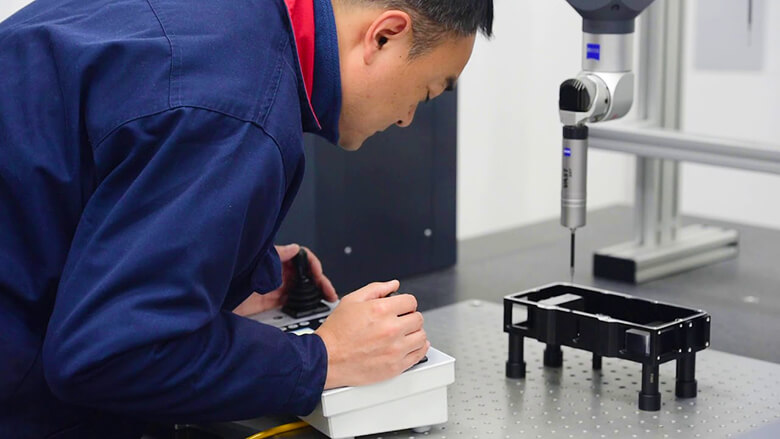
Typical PPAP documentation can include:
| PPAP Element | Purpose |
|---|---|
| Part Submission Warrant | Confirms production approval status |
| Dimensional Results | Verifies drawing dimensions |
| Material Certifications | Confirms material requirements |
| Process Flow Diagram | Documents the manufacturing process |
| Control Plan | Defines production inspection controls |
| PFMEA | Identifies and evaluates process risks |
| Sample Parts | Provides representative production parts |
| Capability Studies | Evaluates process consistency |
ISO 9001 is one of the most widely recognized quality management standards, but CNC part quality also depends on dimensional inspection, material control, process control, tolerances, and customer-specific requirements.
FAI focuses on verifying the first manufactured part against the engineering requirements. PPAP is a broader production approval process that can include FAI results, process documentation, control plans, PFMEA, material certifications, and other records.
Material certification is commonly required when material grade, mechanical properties, chemical composition, or traceability is important to the application or customer specification.
Yes. Depending on the project requirements, CNC manufacturers can prepare dimensional inspection reports, FAI/ISR documentation, PPAP documentation, material certifications, and other quality records.
FAI focuses on verifying the first manufactured part against the engineering requirements. PPAP is a broader production approval process that can include FAI results, process documentation, control plans, PFMEA, material certifications, and other records.
From material certification and dimensional inspection to FAI, PPAP, and surface roughness verification, Kintec Machining provides quality control for prototype, low-volume, and production CNC components.
Send your drawings and quality requirements to our engineering team to discuss the right inspection and documentation package for your CNC machining project.
Send your drawings for a free review and quick quote. Our engineers are here to help.
ISO certified | Fast delivery | Factory Direct