


Call us and get your quote!
10% Off Your First Custom Part
-Start Today!
Send your drawings for a free review and quick quote. Our engineers are here to help.
ISO certified | Fast delivery | Factory Direct

Heat treatment is a controlled heating and cooling process used to modify the mechanical properties of CNC machined metal parts. Depending on the material and application, heat treatment can improve hardness, strength, toughness, wear resistance, machinability, and dimensional stability.
For CNC machined components, the correct heat treatment should be selected according to the material grade, required hardness, part geometry, operating environment, and performance requirements. Common processes include annealing, stress relieving, quenching, tempering, case hardening, and precipitation hardening.
Kintec Machining provides CNC machining and heat treatment solutions for precision components used in demanding industrial applications.
Heat treatment is a controlled manufacturing process in which a metal part is heated to a specified temperature, held for a defined period, and then cooled at a controlled rate. The process changes the material’s microstructure and therefore its mechanical properties.
For CNC machined parts, heat treatment can be performed before machining, between machining operations, or after machining. The appropriate timing depends on the material and the required final properties.
| Heat Treatment | Main Purpose | Typical Materials |
|---|---|---|
| Annealing | Improve machinability and ductility | Steel, stainless steel, aluminum |
| Stress Relieving | Reduce residual stress and distortion | Steel, aluminum, stainless steel |
| Quenching | Increase hardness and strength | Carbon steel, alloy steel, tool steel |
| Tempering | Reduce brittleness after quenching | Alloy steel, tool steel |
| Case Hardening | Increase surface hardness while retaining a tough core | Low-carbon steel |
| Precipitation Hardening | Increase strength and hardness | Aluminum alloys, 17-4 PH stainless steel |
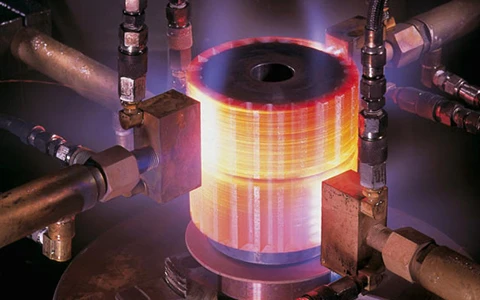
Heat treatment allows engineers to tailor the mechanical properties of a CNC machined component to its intended application.
The main benefits include:
Hardening processes can increase the hardness of metal components, helping them resist surface wear, indentation, and deformation.
Heat treatment can increase tensile and yield strength, allowing components to withstand higher mechanical loads.
A harder surface can improve resistance to friction and repeated contact, making heat-treated parts suitable for gears, shafts, bushings, tooling components, and other wear-prone applications.
Stress relieving can reduce residual stresses introduced by machining, forming, welding, or other manufacturing operations. This helps improve dimensional stability and reduce the risk of distortion.
Annealing can soften certain metals and improve ductility, making them easier to machine and reducing machining difficulty.
Different heat treatment methods produce different combinations of hardness, strength, toughness, and dimensional stability. The right process depends on the material and final application.
Annealing heats a metal to a specified temperature and then cools it slowly. This process generally softens the material, improves ductility, reduces internal stress, and improves machinability.
Annealing is commonly used before CNC machining when a material needs to be easier to cut or when internal stresses need to be reduced.
Typical applications:
Steel components, aluminum alloys, formed metal parts, and materials requiring improved machinability.
Stress relieving uses controlled heating and cooling to reduce residual stresses without significantly changing the material’s overall microstructure.
It is particularly useful for CNC components with large dimensions, complex geometries, thin walls, or tight dimensional requirements.
Typical applications:
Machine components, structural parts, precision fixtures, large CNC machined components.
Quenching involves heating a suitable metal to a specified temperature followed by rapid cooling. Depending on the material and process, cooling may use oil, water, air, or another controlled medium.
Quenching can significantly increase hardness and strength, but it may also increase brittleness and distortion risk. For this reason, quenching is often followed by tempering.
Typical applications:
Gears, shafts, tooling components, high-strength steel parts.
Tempering is normally performed after quenching. The hardened material is reheated to a controlled temperature and then cooled.
The purpose is to reduce excessive brittleness while maintaining an appropriate level of hardness and strength.
Typical applications:
Alloy steel parts, tool steel components, shafts, gears, and high-load mechanical components.
Case hardening increases the hardness of the outer surface while maintaining a relatively tougher and more ductile core.
Carburizing is a common case-hardening method for low-carbon steels. It is useful when a component needs high surface wear resistance without making the entire part excessively brittle.
Typical applications:
Gears, pins, shafts, cams, bushings, and components exposed to repeated surface contact.
Precipitation hardening, also called age hardening, increases the strength and hardness of certain alloys through controlled heating, cooling, and aging.
It is commonly used with precipitation-hardening aluminum alloys and stainless steels such as 17-4 PH. Common examples include 6061-T6, 7075-T6, and 17-4 PH stainless steel.
Typical applications:
Aerospace components, automotive components, high-strength brackets, precision mechanical parts, and high-performance equipment.
Not every CNC machining material responds to heat treatment in the same way. The treatment must be selected according to the alloy composition and required material properties.
| Material | Common Heat Treatment | Typical Purpose |
|---|---|---|
| Carbon Steel | Annealing, quenching, tempering, case hardening | Hardness, strength, wear resistance |
| Alloy Steel | Quenching, tempering, stress relieving | Strength and toughness |
| Tool Steel | Annealing, hardening, tempering | High hardness and wear resistance |
| Stainless Steel | Annealing, stress relieving, precipitation hardening | Strength, corrosion resistance, dimensional stability |
| Aluminum | Solution treatment, quenching, aging | Strength and hardness |
| Titanium | Stress relieving, annealing, aging for selected alloys | Strength and dimensional stability |
The exact treatment and parameters should always be specified according to the material grade and applicable material standard.
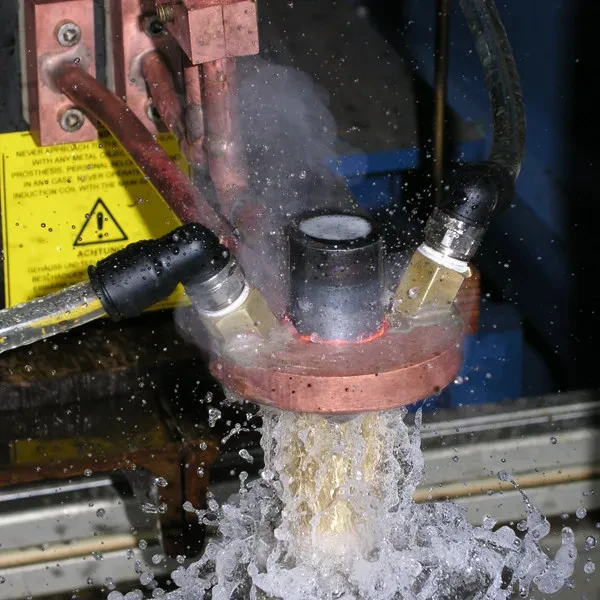
Heat treatment can be incorporated at different stages of CNC manufacturing.
Heat treatment before machining is often used to improve machinability or prepare standardized material for manufacturing. Annealed material, for example, can be easier to machine because of its reduced hardness and improved ductility.
For complex components, stress relieving may be performed between machining stages. This can help reduce residual stress and improve dimensional stability before final machining.
Heat treatment after machining is common when the final component requires increased hardness, strength, or wear resistance.
For example, a steel component can be CNC machined while the material remains relatively machinable and then hardened and tempered to achieve its required final mechanical properties.
Heat treatment can affect the dimensional accuracy of CNC machined parts because heating and cooling may cause material expansion, contraction, residual stress changes, or distortion.
For parts with tight tolerances, engineers should consider the heat treatment process during the initial manufacturing plan rather than treating it as an afterthought.
A typical strategy is:
Rough machining → stress relieving or heat treatment → semi-finish machining → final machining → inspection
For highly precise components, the required hardness, heat treatment condition, final dimensions, and machining tolerances should be clearly defined on the engineering drawing.
When ordering CNC machined parts, engineers should provide as much heat treatment information as possible.
Recommended specifications include:
Material grade
Heat treatment type
Required hardness
Applicable material or industry standard
Heat treatment condition or temper designation
Case depth when case hardening is required
Critical dimensional tolerances
Surface finish requirements
Inspection requirements
For example, specifying 17-4 PH stainless steel with an appropriate precipitation-hardening condition is more precise than simply requesting “heat treated stainless steel.”
For steels, specifying a required hardness range such as HRC can also help manufacturers select and verify the appropriate treatment.
Improves hardness and strength
Increases wear resistance
Improves toughness when correctly applied
Reduces residual stress
Can improve dimensional stability
Extends component service life
Allows material properties to be optimized for specific applications
Adds manufacturing cost and lead time
Can cause distortion or dimensional changes
May increase surface oxidation
Some materials have limited heat-treatment response
Improper treatment can create excessive hardness or brittleness
Because heat treatment can influence final dimensions, tolerances and inspection requirements should be considered together with the CNC machining process.
The best heat treatment depends on the performance requirement rather than simply the material name.
| Application Requirement | Recommended Approach |
|---|---|
| Improve machinability | Annealing |
| Reduce machining stress | Stress relieving |
| Increase overall hardness | Quenching + tempering |
| Improve surface wear resistance | Case hardening |
| Increase aluminum alloy strength | Precipitation hardening / aging |
| Improve dimensional stability | Stress relieving |
| Balance hardness and toughness | Quenching + tempering |
For example, a gear requiring wear resistance may benefit from case hardening, while a high-strength aerospace aluminum component may require a precipitation-hardening condition. A large precision steel component may benefit from stress relieving to control dimensional changes during subsequent machining.
Heat-treated CNC components are used across industries where mechanical performance, durability, and dimensional stability are critical.
Used for high-strength brackets, structural components, housings, shafts, and precision mechanical parts.
Common applications include gears, shafts, brackets, transmission components, and other wear-resistant parts.
Heat-treated stainless steel and titanium components can be used in precision equipment and mechanical assemblies where controlled material properties are required.
Robotic joints, shafts, precision mechanisms, and transmission components can benefit from improved hardness and wear resistance.
Heat treatment is widely used for machine components that experience repeated loading, friction, impact, or high mechanical stress.
Kintec Machining integrates CNC machining with appropriate post-processing options to help customers manufacture functional, production-ready components.
Our CNC manufacturing capabilities include:
3-axis and 5-axis machining
Rapid prototyping
Low-volume production
Heat treatment
Dimensional inspection
Our engineers can review your material, drawing, tolerance, hardness requirement, geometry, and application to help determine an appropriate manufacturing process.
Whether you need a prototype or production batch, defining the heat treatment requirement early can help reduce dimensional risks, unnecessary processing, and production delays.
Choose the right combination of material, CNC machining process, heat treatment, tolerances, and inspection for your application. Share your CAD files and technical drawings with Kintec Machining to discuss the appropriate manufacturing solution for your precision components.
Send your drawings for a free review and quick quote. Our engineers are here to help.
ISO certified | Fast delivery | Factory Direct