


Call us and get your quote!
10% Off Your First Custom Part
-Start Today!
Send your drawings for a free review and quick quote. Our engineers are here to help.
ISO certified | Fast delivery | Factory Direct

Choosing between aluminum, stainless steel, brass, copper, titanium, steel, and engineering plastics can significantly affect the performance, cost, tolerance, and lead time of a CNC machined part.
The best material for CNC machining depends on the application—not simply the material with the highest strength. A lightweight robotics housing may require aluminum, while a medical component may need stainless steel or titanium. An electrical connector may perform better in copper or brass, while a low-friction component may require an engineering plastic such as POM or PEEK.
This CNC machining materials comparison explains the key differences between common materials and helps engineers, sourcing managers, and product developers select the right option for their application.
The following table provides a practical starting point for comparing common CNC machining materials.
| Material | Strength | Weight | Corrosion Resistance | Machinability | Typical Applications |
|---|---|---|---|---|---|
| Aluminum | Medium to high | Very low | Good | Excellent | Aerospace, robotics, automotive, electronics |
| Stainless Steel | High | High | Excellent | Moderate | Medical, industrial, food equipment |
| Brass | Medium | High | Good | Excellent | Fittings, connectors, valves |
| Copper | Medium | High | Excellent | Moderate | Electrical and thermal components |
| Titanium | Very high | Low | Excellent | Challenging | Aerospace, medical, high-performance parts |
| Carbon & Alloy Steel | High to very high | High | Variable | Moderate | Automotive, machinery, structural parts |
| Engineering Plastics | Low to medium | Very low | Often excellent | Good | Insulators, seals, housings, medical components |
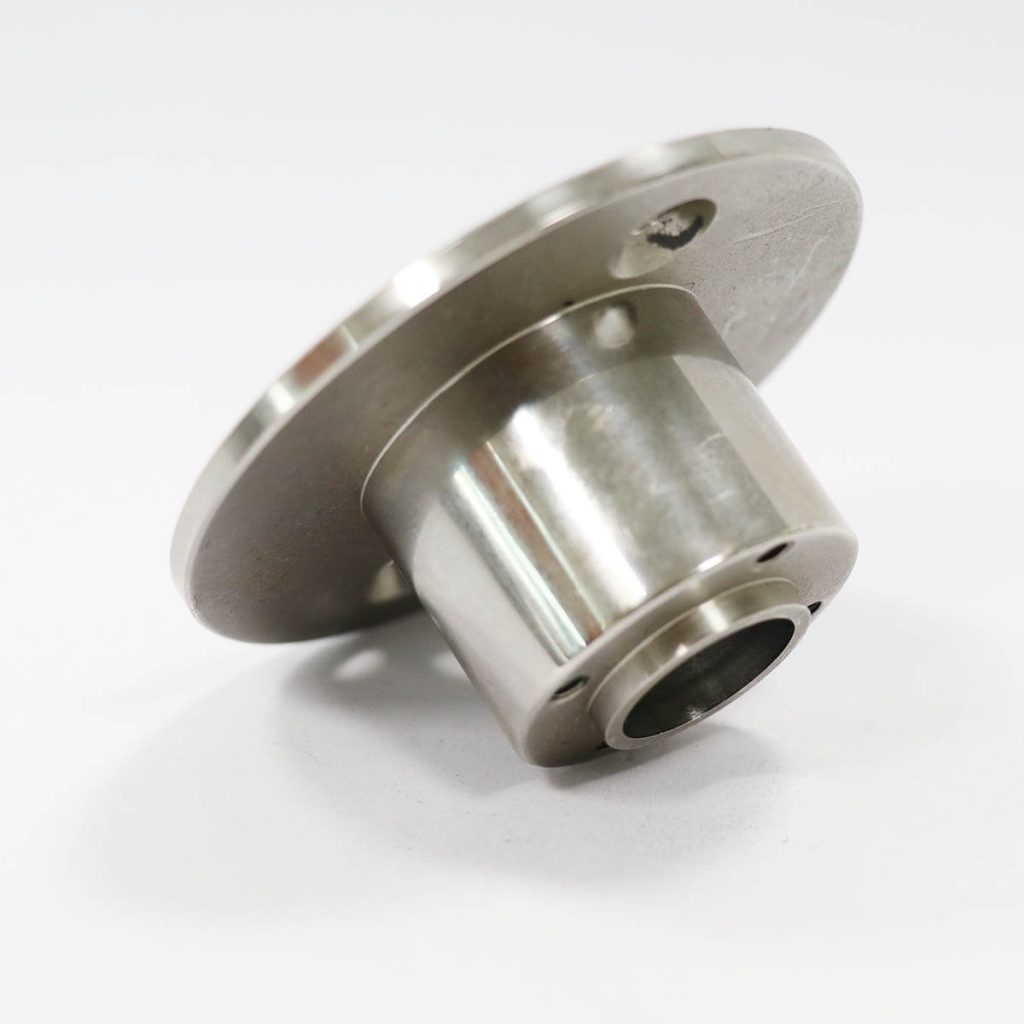
Kintec Machining supports a wide range of CNC machining materials, including aluminum, stainless steel, brass, copper, steel, titanium, and engineering plastics. The available material selection includes multiple grades for different strength, corrosion resistance, conductivity, and application requirements.
Aluminum is often the first choice when low weight, excellent machinability, and efficient production are priorities. Common grades include 6061-T6, 7075, 2024, 5052, and 6082.
Compared with stainless steel, aluminum is significantly lighter and generally faster to machine. This makes it well suited for aerospace brackets, robotic arms, electronic housings, heat sinks, and automotive prototypes.
For example, a robotics manufacturer may choose 6061 aluminum for a custom actuator housing to reduce moving mass. A high-strength aerospace bracket may instead use 7075 aluminum where strength-to-weight ratio is more important.
Stainless steel is a better choice when a component must withstand corrosion, repeated mechanical loads, wear, or demanding operating environments. Common grades include 303, 304, 316, 316L, 440C, and 17-4 PH.
Stainless steel is heavier and generally more difficult to machine than aluminum, which can increase machining time and tool wear. However, its durability and corrosion resistance can provide better long-term performance.
For example, 316 stainless steel may be selected for a component exposed to moisture or corrosive environments, while 17-4 PH stainless steel may be used for high-strength industrial or aerospace parts.
Brass and copper are both widely used in precision CNC machining, but their strengths are different.
| Property | Brass | Copper |
|---|---|---|
| Machinability | Excellent | Moderate |
| Electrical Conductivity | Good | Excellent |
| Thermal Conductivity | Good | Excellent |
| Corrosion Resistance | Good | Excellent |
| Typical Use | Fittings, valves, connectors | Busbars, contacts, heat transfer parts |
Brass is often the better choice for complex turned parts, threaded fittings, valves, and connectors because it machines efficiently and provides good dimensional stability.
Copper is preferred when electrical or thermal conductivity is the primary requirement. For example, a CNC machined copper electrical contact may outperform brass where low electrical resistance is critical.
Titanium offers higher performance than aluminum in demanding applications, but it also costs more and requires more careful machining.
| Property | Aluminum | Titanium |
|---|---|---|
| Weight | Very low | Low |
| Strength | Medium to high | Very high |
| Corrosion Resistance | Good | Excellent |
| Machinability | Excellent | Challenging |
| Relative Production Cost | Lower | Higher |
| Typical Applications | Housings, brackets, frames | Aerospace, implants, high-performance parts |
For example, an aerospace component subjected to high loads and corrosive conditions may justify titanium Ti-6Al-4V. A less demanding structural bracket may achieve the required performance at a lower cost using 7075 aluminum.
The key question is not “Which material is stronger?” but rather “What performance does the part actually require?”
Engineering plastics can be a better choice than metal when low weight, electrical insulation, chemical resistance, or low friction is important.
Common CNC machining plastics include POM, PEEK, PA6, PC, ABS, PEI, PPS, and PTFE.
For example:
POM: Low-friction gears, bushings, and precision mechanical components
PEEK: High-performance medical, chemical, and industrial components
ABS: Functional prototypes and housings
PA6: Wear-resistant mechanical components
PC: Transparent or impact-resistant components
However, plastics can experience greater thermal expansion than metals. Engineers should consider temperature, clamping pressure, wall thickness, and material flexibility when specifying CNC machining tolerances.

Material properties directly influence achievable dimensional accuracy. Hardness, thermal expansion, stiffness, and heat generation during machining all affect tolerance control.
| Application | Typical Tolerance Consideration |
|---|---|
| General non-critical features | Around ±0.13 mm |
| Mating surfaces | Around ±0.025 mm |
| Precision fits and alignment | Around ±0.013 mm or tighter |
| Critical aerospace or medical features | Project-specific, potentially ±0.005 mm |
These values are general manufacturing references rather than universal guarantees. The actual tolerance depends on material, geometry, part size, machining process, and drawing requirements.
Kintec Machining reports capabilities down to approximately ±0.0002 in for selected precision features, with tighter tolerances evaluated according to technical drawings and part requirements.
A common manufacturing mistake is specifying extremely tight tolerances on every dimension. A better approach is to apply tight tolerances only to surfaces that locate, mate, seal, or perform a critical function. This can reduce inspection requirements, machining costs, and lead times.
Material selection is one factor that influences lead time, but it is not the only one.
Production time may also depend on:
Part complexity
Required CNC machining tolerances
Quantity
Number of setups
3-axis, 4-axis, or 5-axis machining requirements
Surface finishing
Heat treatment
Inspection and documentation
As a practical example, a simple aluminum prototype may be produced faster than a complex titanium component requiring 5-axis machining and additional inspection. Similarly, a low-volume stainless steel medical component may require more processing time than a high-volume brass connector.
For prototypes and low-volume production, CNC machining can eliminate the tooling lead time associated with injection molding or die casting. This makes it particularly useful for product development, engineering validation, and bridge production.
Use the following guidelines as a starting point:
Choose aluminum for lightweight, cost-effective, highly machinable parts.
Choose stainless steel for corrosion resistance, durability, and demanding environments.
Choose brass for excellent machinability, fittings, and precision turned components.
Choose copper for electrical and thermal conductivity.
Choose titanium for high strength-to-weight performance and demanding aerospace or medical applications.
Choose carbon or alloy steel for high strength, wear resistance, and mechanical components.
Choose engineering plastics for low weight, insulation, chemical resistance, or low-friction applications.
The right choice should always be evaluated together with the part geometry, CNC process, required tolerance, surface finish, production quantity, and target lead time.
Material selection affects much more than the raw material price. It influences part performance, CNC machining tolerances, surface finish, production cost, inspection requirements, and lead time.
Kintec Machining is a China-based CNC machining manufacturer providing CNC milling, CNC turning, 5-axis machining, Swiss machining, rapid prototyping, and low-volume production. With experience supporting aerospace, medical, automotive, robotics, electronics, and other demanding industries, Kintec can help evaluate the right material and manufacturing process for your part.
Send your drawings for a free review and quick quote. Our engineers are here to help.
ISO certified | Fast delivery | Factory Direct