


Call us and get your quote!
10% Off Your First Custom Part
-Start Today!
Send your drawings for a free review and quick quote. Our engineers are here to help.
ISO certified | Fast delivery | Factory Direct

The best material for a CNC machined part depends heavily on where the part will operate. A component used in saltwater requires different properties from one used inside a high-temperature aerospace system, medical device, or electrical enclosure.
When selecting CNC machining materials, engineers and sourcing managers should evaluate corrosion resistance, temperature stability, strength, wear resistance, electrical conductivity, weight, machinability, and cost. The right choice can improve service life and reduce manufacturing risks. The wrong material can lead to corrosion, deformation, premature wear, or unnecessary production costs.
This guide explains which materials are best suited for different operating environments and how material selection affects CNC machining tolerances, lead times, and applications.
| Operating Environment | Recommended Materials | Main Reason |
|---|---|---|
| Marine or humid | 316 stainless steel, titanium, aluminum | Corrosion resistance |
| High-temperature | Stainless steel, titanium, PEEK | Thermal stability |
| High-wear | Tool steel, 17-4 PH stainless steel, POM | Wear resistance |
| Electrical | Copper, brass, aluminum | Conductivity |
| Lightweight aerospace | Aluminum, titanium | Strength-to-weight ratio |
| Medical | Stainless steel, titanium, PEEK | Strength, corrosion resistance, biocompatibility |
| Chemical exposure | PEEK, PTFE, stainless steel | Chemical resistance |
| General industrial | Aluminum, steel, stainless steel | Balanced performance and cost |

Kintec Machining supports a broad range of CNC machining materials, including aluminum, stainless steel, brass, copper, steel, titanium, and engineering plastics such as PEEK, POM, and other technical polymers.
Stainless steel is widely used in marine, industrial, food-processing, and medical environments where moisture and corrosion are concerns.
316 and 316L stainless steel are often considered when exposure to moisture, salts, or corrosive chemicals is expected. For less aggressive environments, 304 stainless steel may provide a good balance between performance and cost.
A practical example is a CNC machined pump housing or marine mounting component. Selecting 316 stainless steel instead of a standard carbon steel can help reduce corrosion-related maintenance and extend service life.
Titanium offers excellent corrosion resistance while maintaining a high strength-to-weight ratio. It is particularly useful in aerospace, marine, and medical applications.
However, titanium is more difficult to machine than aluminum or brass. The additional tooling and process control requirements can increase production cost and lead time.
High-temperature applications require materials that maintain dimensional stability and mechanical performance as temperatures change.
| Material | High-Temperature Suitability | Typical Applications |
|---|---|---|
| Aluminum | Moderate | Housings and heat-management components |
| Stainless Steel | Good | Industrial and aerospace components |
| Titanium | Excellent for many demanding applications | Aerospace and medical parts |
| PEEK | Excellent for high-performance plastics | Insulators and technical components |
For example, a component near an engine or high-temperature industrial system may require stainless steel or titanium rather than a standard plastic.
PEEK can be useful where a lightweight, electrically insulating, and chemically resistant material is required. However, the actual operating temperature and load conditions should be confirmed before material approval.
Parts exposed to repeated sliding, contact, or mechanical movement require good wear resistance and dimensional stability.
Alloy steels such as 4140 and 4340 can be used for shafts, mechanical components, and high-load parts. Certain stainless steels, including 17-4 PH and 440C, may be selected when strength, hardness, and corrosion resistance are required.
POM is often used for gears, bushings, rollers, and low-friction components. It can reduce weight and noise compared with metal parts.
For example, a robotic mechanism may use a POM bushing where low friction and reduced weight are more important than maximum structural strength.
Copper is often the first choice for electrical contacts, busbars, heat-transfer components, and other applications where conductivity is critical.
The trade-off is that copper can be more challenging to machine than brass and may require careful control of cutting conditions and surface finish.
Brass offers good electrical conductivity while being highly machinable. This makes it suitable for connectors, terminals, fittings, and precision electrical components.
| Requirement | Best Material Choice |
|---|---|
| Maximum electrical conductivity | Copper |
| Easier machining with good conductivity | Brass |
| Lightweight conductive housing | Aluminum |
| Electrical insulation | Engineering plastics |
Weight is a major consideration in aerospace, robotics, drones, and other moving systems.
6061 aluminum is widely used for general structural components, housings, brackets, and prototypes. 7075 aluminum may be preferred when higher strength is required.
For example, a robotic arm housing may use aluminum to reduce moving mass and motor load. The material is also highly machinable, which can support shorter machining cycles and competitive lead times.
Titanium is useful when an application requires a combination of low weight, high strength, and corrosion resistance. A complex aerospace bracket may benefit from 5-axis CNC machining to reduce setups and improve access to curved or angled surfaces.
Medical applications often require a combination of strength, corrosion resistance, dimensional stability, and material compliance.
Stainless steel and titanium are common choices for precision medical components. PEEK may be selected for specialized components requiring low weight, chemical resistance, or electrical insulation.
For medical parts, material selection should be evaluated together with documentation, traceability, surface finish, cleaning requirements, and the intended application.
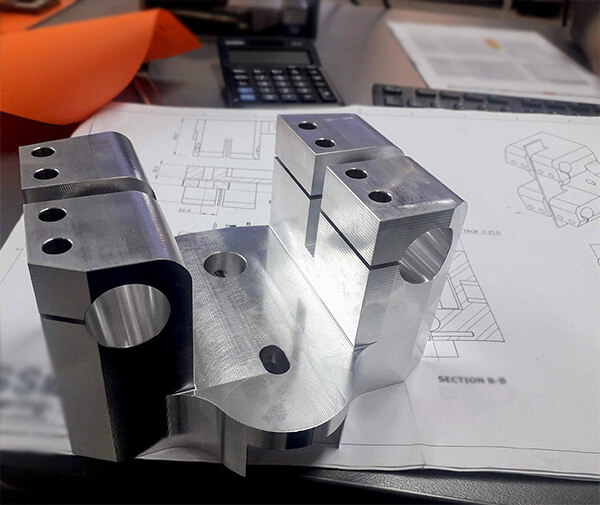
Environmental conditions can affect the dimensional performance of a part after machining.
Temperature changes may cause thermal expansion. Moisture can affect certain materials. Mechanical loads can cause deformation, particularly in thin-walled components.
| Environment | Main Tolerance Concern |
|---|---|
| High temperature | Thermal expansion |
| Low temperature | Dimensional contraction |
| Heavy mechanical loads | Deflection |
| Thin-wall design | Distortion during machining |
| Plastic components | Temperature-related dimensional change |
Kintec Machining can manufacture parts to tight tolerances based on technical drawings and feature requirements. Its CNC machining services can achieve approximately ±0.0002 in on selected critical features, while general tolerances are applied according to the drawing and manufacturing requirements.
For cost control, tight tolerances should be applied only to features that mate, locate, seal, or perform a critical function.
Material availability and machinability can directly affect CNC production lead times.
A readily available grade of aluminum may be faster to source and machine than a specialty titanium alloy. Similarly, a free-machining brass or 303 stainless steel grade may support efficient production for precision turned parts.
Lead time can also increase when a project requires:
Special material certification
Heat treatment
Tight CNC machining tolerances
5-axis machining
Special surface finishing
CMM inspection
Low-volume production with complex setups
For prototypes and low-volume production, CNC machining provides flexibility without the tooling requirements of injection molding or die casting. Kintec supports rapid prototyping and low-volume production for applications across aerospace, medical, automotive, robotics, and electronics.
Material selection should begin with the environment in which the part will operate. Corrosion, heat, wear, weight, electrical requirements, and chemical exposure all influence the best material choice.
Kintec Machining is a China-based CNC machining manufacturer specializing in CNC milling, CNC turning, 5-axis machining, Swiss machining, rapid prototyping, and low-volume production. Its material capabilities include aluminum, stainless steel, brass, copper, steel, titanium, and engineering plastics for aerospace, medical, automotive, robotics, electronics, and industrial applications.
Send your drawings for a free review and quick quote. Our engineers are here to help.
ISO certified | Fast delivery | Factory Direct