5-Axis CNC Machining: A Complete Guide for Complex Precision Parts
Introduction
As industries demand increasingly complex geometries and tighter tolerances, traditional 3-axis machining is no longer enough for many high-end applications. 5-axis CNC machining has become the go-to solution for producing intricate parts in aerospace, medical, automotive, and robotics industries.
In this guide, we’ll explain what 5-axis CNC machining is, how it works, its advantages, and when you should choose it over conventional CNC processes.
What Is 5-Axis CNC Machining?
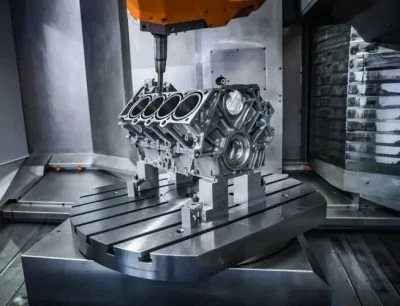
5-axis CNC machining is an advanced manufacturing process in which the cutting tool moves across five different axes simultaneously — three linear axes (X, Y, Z) plus two rotational axes (commonly A and B, or A and C).
This allows the machine to approach the workpiece from virtually any direction, making it possible to produce highly complex custom CNC parts in a single setup, without manual repositioning.
Compared to traditional 3-axis machining, 5-axis machining delivers superior precision, shorter lead times, and the ability to manufacture geometries that would otherwise be impossible.
How Does 5-Axis CNC Machining Work?
The 5-axis machining workflow typically follows these steps:
- CAD Design: A detailed 3D model of the part is created in CAD software.
- CAM Programming: Specialized 5-axis CAM software generates the tool paths and converts them into G-code.
- Machine Setup: The operator fixtures the workpiece and loads the required cutting tools.
- Simultaneous 5-Axis Machining: The machine moves the tool (or table) along five axes at once, removing material from multiple angles.
- Inspection & Finishing: Finished parts are measured with CMM or other precision instruments, then surface-finished as required.
Types of 5-Axis CNC Machining
- 3+2 Axis Machining (Indexed): The two rotational axes position the part, then the machine cuts in 3-axis mode. Cost-effective for moderately complex parts.
- Full 5-Axis Simultaneous Machining: All five axes move at the same time, enabling true freeform surfaces and complex contours such as turbine blades and medical implants.
- Mill-Turn (5-Axis Turning Centers): Combines turning and milling capabilities in a single machine, ideal for shaft-like parts with complex features.
Advantages of 5-Axis CNC Machining
- Machines complex geometries in a single setup
- Higher accuracy and tighter tolerances (down to ±0.0002″)
- Better surface finish thanks to shorter, more rigid tools
- Reduced setup time and fewer fixturing errors
- Shorter lead times for prototypes and small-to-medium batches
- Lower scrap rate compared to multi-setup 3-axis machining
Common Materials Used in 5-Axis Machining
5-axis CNC machining handles a wide range of metals and engineering plastics, including:
- Aluminum (6061, 7075, 2024)
- Stainless Steel (304, 316, 17-4PH)
- Titanium (Ti-6Al-4V, TA2)
- Inconel and other superalloys
- Brass and Copper
- Engineering plastics (PEEK, POM, PTFE, PEI)
The right material depends on your part’s mechanical requirements, operating environment, and budget.
Applications of 5-Axis CNC Machining
5-axis CNC machining is the preferred process across industries that demand precision and complex geometry:
Aerospace (impellers, turbine blades, structural brackets) / Medical (orthopedic implants, surgical instruments) / Automotive (cylinder heads, transmission components) / Robotics (joint housings, end-effectors) / Energy (oilfield connectors, custom valves) / Defense (optical mounts, weapon components)
It is especially suitable for parts with curved surfaces, undercuts, deep cavities, and tight tolerances.
5-Axis vs 3-Axis CNC Machining
| Feature | 5-Axis CNC Machining | 3-Axis CNC Machining |
|---|---|---|
| Axes of Motion | 5 (X, Y, Z + 2 rotary) | 3 (X, Y, Z) |
| Setups Required | Usually 1 | Multiple |
| Geometry Complexity | High (freeform surfaces) | Moderate (prismatic) |
| Precision | Very High | High |
| Cost per Part | Higher | Lower |
| Best For | Complex precision parts | Simple to medium parts |
When Should You Choose 5-Axis CNC Machining?
5-axis machining is the right choice when:
- Your part has complex curved surfaces or undercuts
- Multiple setups in 3-axis would compromise accuracy
- You need to reduce lead time and labor cost
- The part requires very tight tolerances (±0.0002″ or better)
- You’re producing aerospace, medical, or high-end industrial components
FAQ
What does 5-axis mean in CNC machining?
It means the cutting tool can move along five different axes simultaneously — three linear (X, Y, Z) and two rotational — giving full access to the workpiece from nearly any angle.
Is 5-axis machining more expensive than 3-axis?
Per-hour rates are higher, but because 5-axis reduces setups, fixturing, and total machining time, it often delivers a lower total cost for complex parts.
What file formats are required for 5-axis CNC machining?
Standard CAD formats such as STEP, IGES, STL, and Parasolid are commonly accepted. A 3D model is required to generate the multi-axis tool paths.
What tolerances can 5-axis CNC machining achieve?
Typical tolerances range from ±0.001″ for general parts down to ±0.0002″ for high-precision aerospace and medical components.
Conclusion
5-axis CNC machining is one of the most powerful manufacturing technologies available today, enabling complex, high-precision parts in a single setup. For engineers and procurement teams working on demanding projects, it offers a balance of accuracy, efficiency, and design freedom that traditional processes simply can’t match.
Struggling with Complex Geometry & Tight Tolerances?
Stop struggling with:
- Inconsistent accuracy from repeated setups
- Impossible tool access on intricate geometries
- Delayed production schedules
Our 5-Axis CNC Solutions handle challenging parts with superior precision and efficiency.